Year End Review 2025: Ministry of Petroleum & Natural Gas
Driving Affordable Energy Access, Infrastructure Expansion & Clean Fuel Transition for a Resilient & Sustainable Energy Future
In 2025, the Ministry of Petroleum & Natural Gas executed a comprehensive, multi-dimensional strategy to secure India’s energy future. Aligning with the national pillars of Energy Access, Efficiency, Sustainability, and Security, the year witnessed transformative reforms in upstream exploration, unprecedented expansion of clean cooking access, the rapid build-out of a national gas grid, and a decisive push towards biofuels and electric mobility infrastructure.
Energy Access & Affordability: Ujjwala’s Unstoppable March
Ensuring universal access to clean cooking fuel remained the flagship priority. The Pradhan Mantri Ujjwala Yojana (PMUY) achieved a monumental milestone, reaching approximately 10.35 crore beneficiaries by 1 December 2025. To achieve saturation, the government approved an additional 25 lakh LPG connections for FY 2025-26, simplifying the process with a single Deprivation Declaration.
Nationwide Safety & Digital Push
Consumer safety was reinforced through the massive Basic Safety Check campaign, conducting over 12.12 crore free safety inspections and replacing more than 4.65 crore LPG hoses at discounted rates. Simultaneously, biometric Aadhaar authentication was accelerated, covering 71% of PMUY consumers, enhancing subsidy targeting and transparency.
2025 By The Numbers: Infrastructure at Scale
Transforming Fuel Retail & Mobility
The retail landscape evolved into integrated energy hubs. Over 90,000 outlets were enabled with digital payments, supported by 2.71 lakh POS terminals. The APNA GHAR initiative established over 500 wayside amenities for truckers, enhancing road safety and rural employment.
A landmark development is the rollout of 4,000 Energy Stations (1,064 already operational) by 2028-29. These hubs offer conventional fuels alongside CNG, LNG, EV charging, and biofuels, embodying the future of integrated mobility.
One Nation, One Gas Grid: A Pipeline Revolution
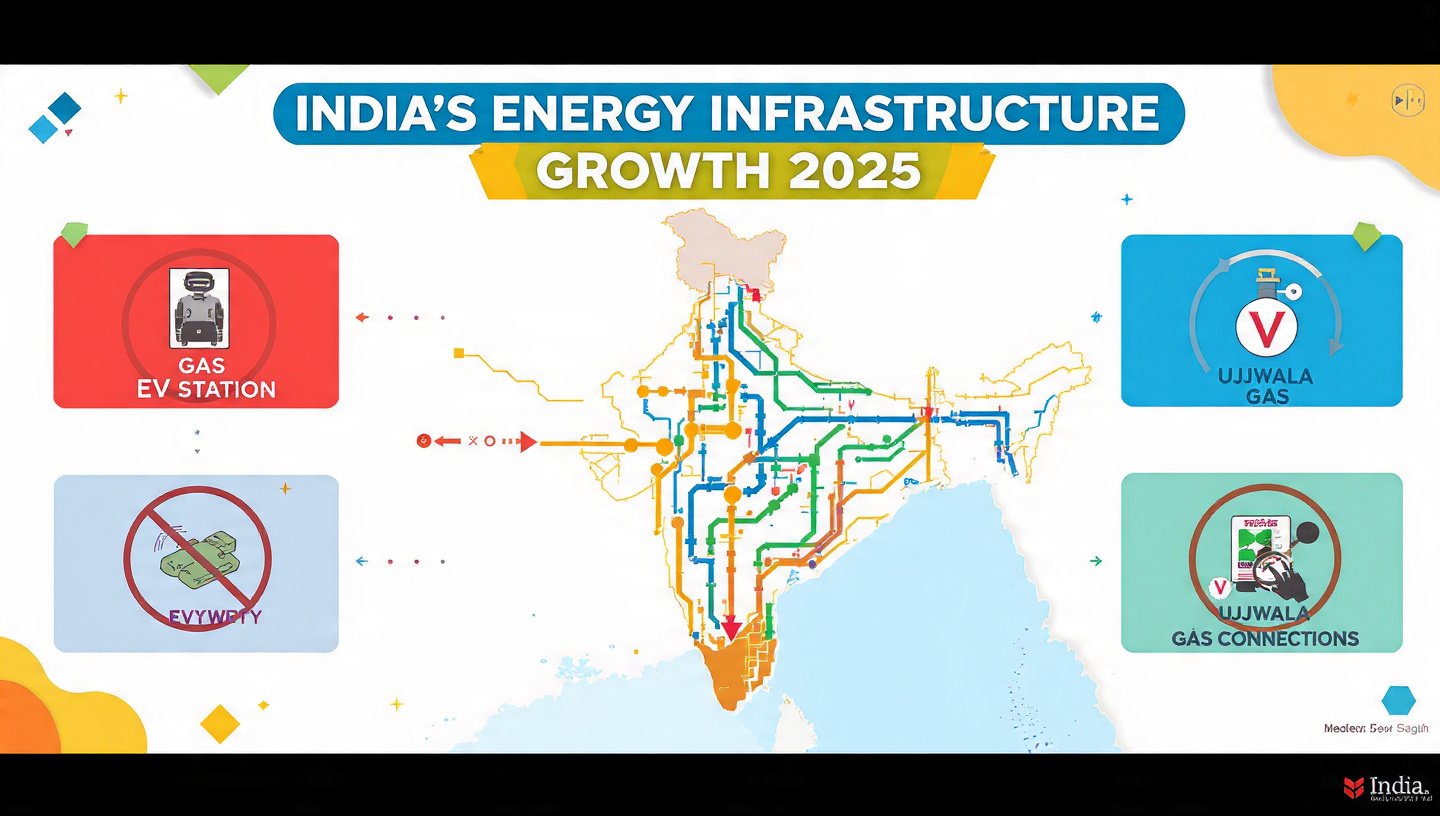
The length of India’s operational natural gas pipeline network has surged from 15,340 km in 2014 to 25,429 km as of June 2025, with another 10,459 km under execution. This creates a fully connected national grid, ensuring equitable gas availability.
The Unified Pipeline Tariff regime (“One Nation, One Grid, One Tariff”) now covers ~90% of operational pipelines, standardizing transportation costs and improving gas affordability nationwide.
- City Gas Distribution (CGD): Expanded to 307 Geographical Areas.
- PNG Connections: ~1.57 crore domestic households connected.
- CNG Stations: Over 8,400 stations nationwide, supporting cleaner transport.
Clean Fuels & Energy Transition: Leading the Green Shift
Biofuels Momentum
India’s ethanol blending program achieved an average of 19.24% in ESY 2024-25, resulting in cumulative forex savings exceeding ₹1.55 lakh crore and significant carbon emission reductions. The SATAT initiative saw over 130 Compressed Bio Gas (CBG) plants commissioned, with mandatory blending in CNG/PNG commencing from FY 2025-26.
Pioneering Sustainable Aviation
2025 marked a decisive step for greener skies. The government set indicative SAF blending targets of 1%, 2%, and 5% for international flights from 2027, 2028, and 2030 respectively. Indian Oil Corporation became the first Indian company to receive ISCC CORSIA certification for SAF production, signing an MoU with Air India for supply.
Strategic Energy Security
National preparedness was bolstered through the strengthening of Strategic Petroleum Reserves (SPR) via international partnerships and progress on Phase-II facilities. Overseas investments by Indian oil PSUs continued to diversify supply sources, underpinning long-term energy security.
Access
Ujjwala saturation, affordability, last-mile delivery.
Infrastructure
Gas grid, Energy Stations, EV charging network.
Sustainability
Ethanol & SAF blending, CBG, emissions reduction.
Security
Upstream reforms, exploration push, SPR expansion.
Through these concerted efforts, the Ministry of Petroleum & Natural Gas has significantly advanced India’s journey towards an affordable, efficient, sustainable, and secure energy ecosystem in 2025, powering the nation’s growth while steering its transition to a greener future.